
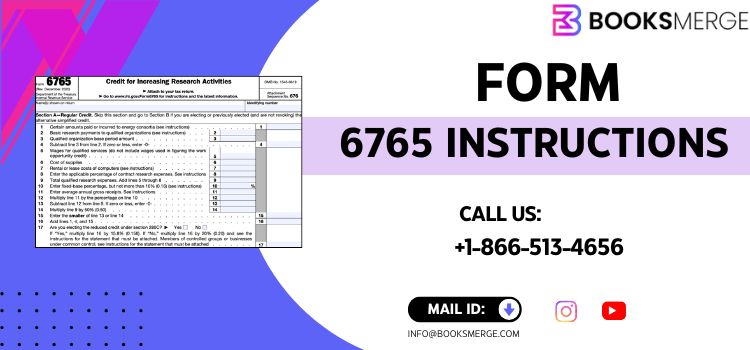
Form 6765 instructions explain how eligible businesses can claim the IRS R&D tax credit by calculating qualified research expenses correctly and reducing income tax or payroll tax liabilities.
Table of Contents
-
Understanding Form 6765
-
What Is Form 6765 Used For
-
Who Qualifies for the R&D Tax Credit
-
What Are Qualified Research Expenses QREs
-
Step by Step Instructions for Form 6765
-
ASC vs Regular Credit Method Explained
-
Documents Required to Support Your Claim
-
Payroll Tax Offset for Startups
-
What Changed in 2025 and Why It Matters in 2026
-
Common Mistakes to Avoid
-
Why Businesses Trust BooksMerge
-
Conclusion
-
FAQs
Understanding Form 6765
IRS Form 6765 allows businesses to claim the federal Research and Development tax credit. This credit rewards companies that invest time and money into innovation. Innovation does not always mean lab coats and microscopes. Software development, product improvements, and engineering upgrades often qualify.
Many business owners ignore this credit because the instructions look intimidating. The irony is that the credit exists to help businesses grow, not scare them away. With the right guidance, Form 6765 instructions become manageable and logical.
The IRS publishes official guidance through Internal Revenue Code Section 41 and related instructions. You can verify all rules directly on the IRS website.
What Is Form 6765 Used For?
Form 6765 is used to calculate and claim the R&D tax credit against federal income tax. Eligible startups may also use it to offset payroll taxes.
Businesses use Form 6765 to:
-
Calculate qualified research expenses
-
Choose a credit calculation method
-
Claim income tax or payroll tax offsets
-
Attach the credit to their federal return
In short, Form 6765 turns innovation into tax savings.
Who Qualifies for R&D Tax Credit?
You do not need to be a tech giant to qualify. Small and mid sized businesses often benefit the most.
A business generally qualifies if it:
-
Develops new or improved products, software, or processes
-
Faces technical uncertainty during development
-
Uses a systematic trial and error approach
-
Relies on engineering, computer science, or similar principles
Manufacturers, software companies, architecture firms, and even food developers often qualify. If your team asks “Will this work?” during development, you may qualify.
For businesses still building financial awareness, this guide on financial literacy statistics offers helpful insight into why tax planning matters.
What Are Qualified Research Expenses QREs?
Qualified Research Expenses form the foundation of Form 6765 instructions. These expenses must directly relate to qualified research activities.
QREs typically include:
-
Wages paid to employees performing research
-
Supplies used during development
-
Contract research costs, usually at 65 percent
General overhead, marketing costs, and routine testing do not qualify. The IRS focuses on technical problem solving, not business experimentation.
Accurate tracking matters here. Guessing numbers may impress nobody except the IRS auditor.
Step by Step Instructions for Form 6765
Part I: Regular Credit Method
This section calculates the credit using historical research spending. It works best for established companies with consistent R&D records.
Part II: Alternative Simplified Credit
The ASC method uses recent years instead of long historical data. Many businesses prefer this method because it simplifies calculations.
Part III: Payroll Tax Election
Qualified startups can elect to apply the credit against payroll taxes. This helps cash flow immediately.
Part IV: Qualified Research Expenses
This section lists wages, supplies, and contract research costs.
Accuracy matters more than speed. Numbers should tie back to payroll and accounting records.
ASC vs Regular Method Explained
How to Calculate ASC vs Regular Method
The regular method compares current year research expenses to a historical base period. It can produce higher credits but requires more data.
The ASC method calculates 14 percent of current QREs above 50 percent of the prior three year average. It sacrifices some credit value for simplicity.
Most small businesses choose ASC because fewer records reduce audit risk.
Documents Required to Support Your Claim
The IRS expects documentation. Not opinions.
You should keep:
-
Payroll records and job descriptions
-
Project notes and technical documentation
-
Expense ledgers for supplies
-
Contractor agreements
Documentation does not need to look fancy. It needs to show intent, experimentation, and technical uncertainty.
Payroll Tax Offset for Startups
Can Startups Use Payroll Offset?
Yes. Qualified startups can offset up to $500,000 of payroll taxes annually. The business must:
-
Have gross receipts under $5 million
-
Have started within the last five years
This feature makes Form 6765 instructions especially valuable for early stage companies that do not yet owe income tax.
What Changed in 2025 and Why It Matters in 2026
The biggest change introduced in 2025 involved Section 174 capitalization rules. Businesses must now amortize research expenses over five years instead of deducting them immediately.
This change increased the importance of Form 6765. Claiming the R&D credit now helps offset the cash flow impact of delayed deductions.
In 2026, smart planning matters more than ever. Businesses that ignore Form 6765 instructions often feel the impact later.
Common Mistakes to Avoid
-
Assuming only labs qualify
-
Failing to document activities
-
Overstating expenses
-
Using inconsistent payroll data
-
Ignoring payroll tax offsets
Mistakes slow refunds and increase audit risk. Precision wins here.
Why Businesses Trust BooksMerge
BooksMerge helps businesses navigate complex tax credits with clarity and confidence. Our team specializes in accounting, payroll, taxation, and data driven compliance.
We focus on accuracy, transparency, and IRS aligned documentation. Clients trust us because we do not guess. We verify.
Need help with Form 6765 instructions or eligibility review? Call +1-866-513-4656 to speak with a specialist who understands innovation driven businesses.
Conclusion
Form 6765 instructions do not need to feel overwhelming. When you understand eligibility rules, QREs, and calculation methods, the R&D tax credit becomes a strategic advantage.
Innovation deserves recognition. The IRS agrees. You just need to file it correctly.
Frequently Asked Questions
What is Form 6765 used for?
Form 6765 calculates and claims the federal R&D tax credit for eligible businesses investing in qualified research activities.
Who qualifies for R&D tax credit?
Businesses developing new or improved products, software, or processes while facing technical uncertainty typically qualify.
What are QREs?
Qualified Research Expenses include wages, supplies, and certain contractor costs directly tied to research activities.
How to calculate ASC vs regular method?
The ASC uses recent years for simplicity, while the regular method relies on historical data and may yield higher credits.
What documents are required?
Payroll records, project documentation, expense reports, and contractor agreements support your claim.
Can startups use payroll offset?
Yes. Qualified startups can apply the credit against payroll taxes even without income tax liability.
What changed in 2025?
Research expenses must now be amortized, making Form 6765 more important for cash flow planning.
Read Also: Form 6765 Instructions