
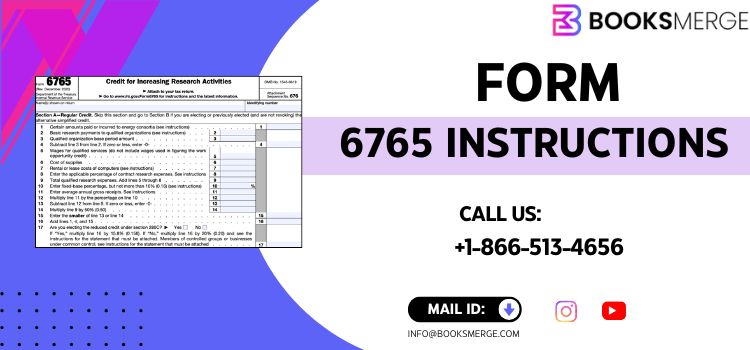
Form 6765 instructions explain how businesses claim the IRS Research and Development tax credit, calculate qualified expenses, and reduce tax or payroll liability while staying compliant with IRS rules.
Table of Contents
-
Introduction to IRS Form 6765
-
What Is Form 6765 Used For?
-
Who Qualifies for the R&D Tax Credit?
-
Understanding Qualified Research Expenses (QREs)
-
Structure of Form 6765 Explained
-
Instructions for Form 6765: Step by Step
-
ASC vs Regular Method Calculation
-
Payroll Tax Offset for Startups
-
What Changed in 2025 for Form 6765?
-
Common Filing Mistakes to Avoid
-
Documentation Requirements
-
Why Accurate Financial Knowledge Matters
-
How BooksMerge Helps Businesses File with Confidence
-
Conclusion
-
Frequently Asked Questions
Introduction to IRS Form 6765
Innovation drives business growth, but innovation also costs money. To reward companies that invest in research and development, the IRS offers the R&D tax credit. IRS Form 6765 is the official form used to claim this benefit.
The IRS Form 6765 instructions guide taxpayers through calculating and reporting the credit correctly. When used properly, this form can significantly reduce income tax or payroll tax liabilities. When used poorly, it can invite audits and headaches.
Let us walk through the instructions Form 6765 requires, using clear logic, real IRS guidance, and a touch of humor. Taxes do not have to feel like a suspense thriller.
What Is Form 6765 Used For?
Form 6765 is used to claim the federal Research and Development tax credit. Businesses file it with their income tax return to report qualified research expenses and calculate the allowable credit.
According to the IRS, the credit exists to encourage innovation within the United States. It applies to companies that develop new or improved products, processes, software, or techniques. No lab coat required.
Who Qualifies for the R&D Tax Credit?
Many businesses assume the credit applies only to large tech companies. That assumption costs money.
You may qualify if your business meets these IRS criteria:
-
You develop or improve products, software, or processes
-
Your work involves technical uncertainty
-
You rely on engineering, computer science, chemistry, or similar sciences
-
You perform substantially all research activities in the United States
Manufacturers, software developers, startups, architecture firms, and even food companies often qualify. If your team experiments, tests, or prototypes, the IRS may see R&D even if you call it problem solving.
Understanding Qualified Research Expenses (QREs)
QREs form the backbone of Form 6765 instructions. The IRS recognizes only specific expenses.
Qualified Research Expenses include:
-
Wages paid to employees performing qualified research
-
Supplies consumed during research activities
-
Contract research costs, generally 65 percent of payments
-
Certain cloud computing expenses related to development
Rent, marketing, and general overhead do not qualify. Coffee for late night coding sessions sadly does not qualify either.
Structure of Form 6765 Explained
Form 6765 contains four main sections:
-
Section A: Regular credit calculation
-
Section B: Alternative Simplified Credit calculation
-
Section C: Current year credit and limitations
-
Section D: Payroll tax election for qualified small businesses
The IRS allows businesses to choose the method that produces the best result. Choosing blindly often leads to missed savings.
Instructions for Form 6765: Step by Step
Following IRS Form 6765 instructions in order helps avoid errors.
Step 1: Identify Qualified Activities
Start by documenting which projects meet the IRS four part test. The IRS explains this test in Treasury Regulation Section 1.41-4.
Step 2: Calculate QREs
Add eligible wages, supplies, and contract research expenses. Use payroll records and general ledger data.
Step 3: Choose Credit Method
Select either the regular method or the Alternative Simplified Credit. More on this shortly.
Step 4: Complete Sections A or B
Enter calculated amounts carefully. One misplaced zero can change everything.
Step 5: Apply Limitations
Use Section C to apply tax liability limits.
Step 6: Payroll Offset Election
Eligible startups complete Section D to offset employer payroll taxes.
Quick Note: Explore the complete IRS form list to easily find, understand, and file the right tax forms for your business or personal needs.
ASC vs Regular Method Calculation
The IRS allows two calculation methods, and both appear in instructions for Form 6765.
Regular Method
This method compares current QREs to a historical base period. It often benefits older companies with stable research spending.
Alternative Simplified Credit
ASC uses 14 percent of current year QREs exceeding 50 percent of the prior three year average. Many businesses prefer ASC due to simpler records.
The IRS confirms both methods under Internal Revenue Code Section 41. A side by side calculation often reveals which method saves more.
Payroll Tax Offset for Startups
Yes, startups can benefit even without income tax liability.
Qualified small businesses can apply up to $500,000 of R&D credit against employer payroll taxes. This feature appears in Section D of Form 6765 instructions.
To qualify, businesses must:
-
Have gross receipts under $5 million
-
Have no gross receipts more than five years ago
This provision helps startups fund innovation before profitability. Cash flow matters more than applause.
What Changed in 2025 for Form 6765?
Form 6765 instructions 2025 reflect stricter substantiation expectations due to IRS enforcement priorities.
Key updates include:
-
Increased emphasis on detailed project descriptions
-
Greater scrutiny of wage allocations
-
Alignment with Section 174 capitalization rules
The IRS now expects clearer narratives connecting expenses to qualified research activities. Vague explanations no longer pass.
Common Filing Mistakes to Avoid
Even smart businesses make mistakes with IRS Form 6765 instructions.
Common issues include:
-
Overstating QREs
-
Including non qualified wages
-
Lacking contemporaneous documentation
-
Using the wrong credit method
Mistakes delay refunds and increase audit risk. Accuracy always beats speed.
Documentation Requirements
The IRS does not require attachments with Form 6765, but it requires documentation upon request.
Maintain records such as:
-
Payroll reports and W-2 allocations
-
Project descriptions and timelines
-
Technical documentation and testing notes
-
Financial statements and expense reports
Strong documentation builds trust. Weak documentation builds letters from the IRS.
Why Accurate Financial Knowledge Matters
Understanding tax credits connects directly to financial literacy. Businesses that understand financial systems make better decisions.
For insights into how small businesses struggle and succeed financially, read this detailed resource on small business financial literacy statistics. Knowledge reduces costly surprises.
How BooksMerge Helps Businesses File with Confidence
At BooksMerge, we combine accounting expertise with practical tax strategy. Our team supports businesses with R&D credit studies, Form 6765 preparation, payroll offsets, and IRS compliant documentation.
We believe trust comes from transparency and accuracy. If you want professional help with IRS Form 6765 instructions, call +1-866-513-4656 and speak with a real expert who understands both numbers and business realities.
Conclusion
Form 6765 offers real savings for innovative businesses, but only when filed correctly. Understanding instructions Form 6765 provides protects your credit, supports compliance, and strengthens financial strategy.
With accurate data, proper documentation, and expert guidance, businesses can turn innovation into measurable tax relief. The IRS rewards preparation, not guesswork.
Frequently Asked Questions
What is Form 6765 used for?
Form 6765 is used to claim the federal Research and Development tax credit and report qualified research expenses to the IRS.
Who qualifies for R&D tax credit?
Businesses that perform qualified research activities involving technical uncertainty and experimentation in the United States may qualify.
What are QREs?
QREs are qualified research expenses such as eligible wages, supplies, and contract research costs defined under IRS rules.
How to calculate ASC vs regular method?
The regular method uses historical base amounts, while ASC uses a three year average comparison. Calculating both often reveals the best option.
What documents are required?
Payroll records, project documentation, technical notes, and financial statements support Form 6765 claims.
Can startups use payroll offset?
Yes. Qualified startups can offset up to $500,000 of employer payroll taxes using the R&D credit.
What changed in 2025?
Form 6765 instructions 2025 emphasize stronger documentation, clearer project descriptions, and closer IRS review of expense allocations.
Read Also: How to fill out a 1040 form