
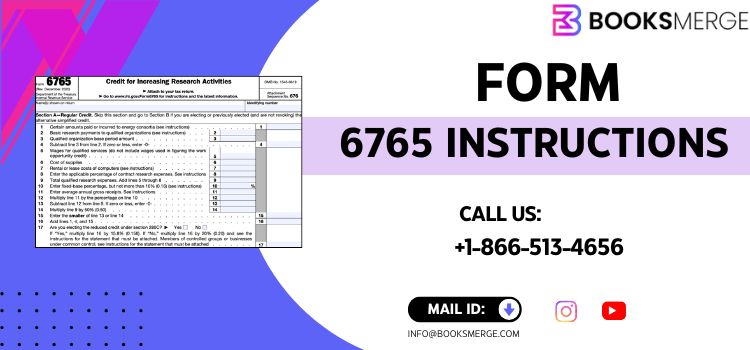
Form 6765 instructions help businesses claim the IRS R&D tax credit by identifying qualified research expenses, calculating the right credit, and maintaining proper documentation for compliance.
Form 6765 Instructions: Complete IRS R&D Tax Credit Guide for 2026
Innovation drives growth, and the IRS wants to reward it. Yet, many businesses miss out because IRS Form 6765 seems intimidating. Numbers, formulas, and IRS jargon can feel overwhelming.
Relax. This guide simplifies Instructions for Form 6765 using real IRS guidance, practical insights, and a touch of humor. By the end, you will understand how to claim the R&D credit efficiently, avoid mistakes, and maximize your savings.
BooksMerge, a trusted accounting, taxation, payroll, and data migration firm, offers these insights. For professional assistance, you can call +1-866-513-4656.
Table of Contents:
-
What Is IRS Form 6765?
-
What Is Form 6765 Used For?
-
Who Qualifies for the R&D Tax Credit?
-
What Are Qualified Research Expenses (QREs)?
-
Instructions for Form 6765: Step-by-Step
-
ASC vs Regular Method: How to Calculate
-
What Documents Are Required?
-
Can Startups Use Payroll Offset?
-
What Changed in 2025 and Its Impact for 2026
-
Common Mistakes to Avoid
-
Why Financial Literacy Improves R&D Credit Claims
-
Conclusion
-
FAQs
What Is IRS Form 6765?
IRS Form 6765 is the official form businesses use to claim the federal Research and Development (R&D) tax credit under Internal Revenue Code Section 41. The credit rewards companies that invest in innovation, from product improvements to software or process development.
The IRS Form 6765 instructions explain how to calculate the credit and apply it against income tax or, for eligible small businesses, payroll taxes. Proper use of this form ensures businesses capture all eligible credits while remaining compliant.
What Is Form 6765 Used For?
Form 6765 allows businesses to:
-
Calculate the federal R&D tax credit
-
Reduce income tax liability
-
Offset payroll taxes for eligible startups
-
Document research activities for IRS compliance
It effectively turns innovation efforts into tax savings while ensuring a proper audit trail.
Who Qualifies for the R&D Tax Credit?
Many companies qualify without realizing it. The IRS applies a four-part test:
-
Activities aim to create or improve a product, process, or software
-
Work relies on principles of science or engineering
-
Technical uncertainty exists and requires experimentation
-
A process of experimentation resolves that uncertainty
Industries like software, manufacturing, engineering, architecture, and biotech often qualify. Small businesses and startups are also eligible, even if they have limited revenue.
What Are Qualified Research Expenses (QREs)?
QREs are the backbone of your credit. They include:
-
Wages paid to employees performing or supervising qualified research
-
Supplies used in research activities
-
Contract research expenses, usually limited to 65% of the cost
Non-qualifying costs include general overhead, marketing, and unrelated administrative expenses. Proper documentation ensures every eligible expense is claimed accurately.
Instructions for Form 6765: Step-by-Step
The instructions divide the form into four main sections:
Section A: Regular Credit
-
Used for the traditional calculation method based on historical fixed-base percentages
-
Requires extensive financial history
Section B: Alternative Simplified Credit (ASC)
-
Preferred by most businesses for simplicity
-
Uses prior three-year QRE averages to calculate the credit
-
Reduces documentation burden
Section C: Credit Limitations
-
Connects the R&D credit to other tax forms and ensures the credit doesn’t exceed limits
Section D: Payroll Tax Election
-
Allows qualified small businesses to apply the credit against payroll taxes
-
Very useful for startups without taxable income
Following instructions carefully reduces mistakes and audit risk.
ASC vs Regular Method: How to Calculate
Regular Method:
-
Based on a fixed-base percentage
-
Requires detailed historical records
-
Can be complex and time-consuming
Alternative Simplified Credit (ASC):
-
14% of QREs above 50% of the prior three-year average
-
Easier and faster to calculate
-
Preferred by most businesses in 2026
Most businesses find ASC simpler and lower risk, while the regular method may suit companies with extensive historical data.
What Documents Are Required?
The IRS expects proof for all claimed R&D expenses. Maintain:
-
Payroll records and employee job descriptions
-
Project documentation and technical notes
-
Time tracking or reasonable allocation estimates
-
Supplier and contractor invoices
-
Financial records linking expenses to research
Accurate records also improve financial literacy and audit preparedness. For more on the importance of financial awareness, check BooksMerge’s insights: Financial Literacy Statistics
Can Startups Use Payroll Offset?
Yes. Qualified small businesses can apply up to $500,000 of the R&D credit against payroll taxes. Requirements include:
-
Gross receipts under $5 million
-
No gross receipts from more than five years ago
-
Proper election filed on Form 6765
This allows startups to gain benefits before profitability, supporting innovation early.
What Changed in 2025 and Its Impact for 2026?
The 2025 updates to Form 6765 instructions include:
-
Greater emphasis on contemporaneous documentation
-
Alignment with Section 174 capitalization rules
-
Clearer reporting expectations for research activities
For 2026, businesses must focus on accurate, detailed reporting of real research activities. Generic statements no longer suffice.
Common Mistakes to Avoid
-
Claiming routine business operations as research
-
Overstating wages without proper documentation
-
Ignoring supplies or contract research proof
-
Forgetting payroll offset elections
-
Filing without professional review
Avoiding these mistakes maximizes credit and minimizes IRS scrutiny.
Why Financial Literacy Improves R&D Credit Claims?
Businesses that track finances well can:
-
Document expenses clearly
-
Allocate wages properly
-
Prepare for audits effectively
BooksMerge emphasizes financial literacy as part of R&D tax credit planning, helping businesses remain compliant while claiming all eligible credits. For professional help, call +1-866-513-4656.
Conclusion
Form 6765 transforms innovation into tangible tax savings when handled correctly. Following IRS Form 6765 instructions ensures eligible credits are claimed, reduces tax liability, and builds compliance credibility. In 2026, precise documentation, accurate calculations, and correct method selection are essential.
Frequently Asked Questions
1. What is Form 6765 used for?
It calculates and claims the federal R&D tax credit for qualifying research activities.
2. Who qualifies for R&D tax credit?
Businesses performing technical experimentation may qualify, regardless of size or profitability.
3. What are QREs?
Qualified Research Expenses include wages, supplies, and contract research tied to eligible R&D.
4. How to calculate ASC vs regular method?
ASC uses recent averages and simpler formulas; the regular method relies on historical data and fixed-base percentages.
5. What documents are required?
Payroll records, technical notes, project documentation, invoices, and financial statements support a valid claim.
6. Can startups use payroll offset?
Yes, eligible startups may apply up to $500,000 of the credit against payroll taxes.
7. What changed in 2025?
The IRS increased documentation requirements, clarified Section 174 alignment, and emphasized detailed research descriptions.
Read Also: Form 6765 Instructions